Sometimes life sucks. Not long after I had posted my last project update, I received some bad news. My mother was in hospital and not doing well. I booked a flight for first thing the next morning. When I got into Calgary to change planes, I learned that she had passed.
The crazy thing is that I had talked to her a few days before. She had sounded a little breathless but otherwise seemed fine. She'd been having problems with swelling and severe itching. She was going back to the hospital the next day for a follow-up. She had had a full battery of testing and, while there were a lot of things that weren't quite right, she'd had them for a long time. We didn't have any indication that there was any immediate concern.
Two days later, she was gone.
Looking back, I'm glad that I saw her when we returned out East this last May. It had crossed my mind that it might be the last time I saw her. The previous May, she'd come to visit us in our new house. I found it concerning about how much difficulty she had in walking and, in particular, how she struggled to climb stairs. But she also displayed an iron will about getting to where she needed to go even though she would take some time to get there. Her only concession was to using a cane when she left the house.
My Mum's great joy was her garden. She came by her green thumb honestly. Her parents had created a prize winning garden in New Brighton, England, despite its modest size. In every house that she lived in, my Mum spent time creating and maintaining its garden. It's fitting that her final garden is her best. It's also fitting that she waged the same war against squirrels that her father did.
So what's next? We're planning a tree planting in Toronto on her birthday. Back here in BC, we're also going to plant a tree for her.
Tuesday, August 27, 2019

Wednesday, July 17, 2019
Project 2mm Terrain: Update 3
✅ 80 ✅ 90 ✅ 100 110 120 130 140 150 160 170 180 190
I have now done the 90 foot contour and the 100 foot contour. The one change to my plans is that I've ended up gluing the paper pattern I used to cut the contours back onto the elevations. I think it will help me with positioning the roads, buildings and creeks later on.

I'm liking how it is looking but it is much, much slower going than I had anticipated. And it will get a lot worse too because the two levels that I did are likely the easiest ones to do. The next 2 levels will be the worst.
There are two "islands" on the left side and I've got one in the above shot. I'm going to the much larger one next and build it up to its apex of 170 feet because it will be useful practice for the rest of the board. I've already learned that I need to cut inside the lines and I shall learn a few more things as I go.
I have now done the 90 foot contour and the 100 foot contour. The one change to my plans is that I've ended up gluing the paper pattern I used to cut the contours back onto the elevations. I think it will help me with positioning the roads, buildings and creeks later on.

I'm liking how it is looking but it is much, much slower going than I had anticipated. And it will get a lot worse too because the two levels that I did are likely the easiest ones to do. The next 2 levels will be the worst.
There are two "islands" on the left side and I've got one in the above shot. I'm going to the much larger one next and build it up to its apex of 170 feet because it will be useful practice for the rest of the board. I've already learned that I need to cut inside the lines and I shall learn a few more things as I go.
Sunday, July 7, 2019
Project 2mm Terrain: Update 2
So, I've spent the last few days tracing out the topographic lines with a different colour for each elevation.

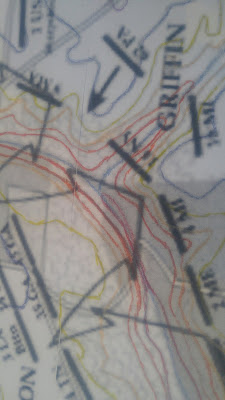 Though tedious, it has been a useful exercise because sometimes the lines get hard to see, obscured by something on the map, or even almost overlapping. Tracing has let me work out what lines apply to each elevation.
It's also let me figure out the general lay of the land. Most of the battle field is at 150-170 feet.
I've also had yet another rethink and I've decided that I'm going to go with a 1mm cork with 2mm foamcore. I just couldn't find any 1mm board that would be sturdy enough so this will be a compromise of the heavy durability of cork and the cheapness of foamcore. It's going to be every second elevation line with the foamcore and the cork providing the step up between.
The next step is cut out the 100 foot mark, use it as a pattern on the foam core. Then I'll do the same for the 90 mark on the cork.
(I also apologize for the really crappy photography. The lens on my phone is so scratched up that all photos no look like they've been taken in a heavy fog.)

 Though tedious, it has been a useful exercise because sometimes the lines get hard to see, obscured by something on the map, or even almost overlapping. Tracing has let me work out what lines apply to each elevation.
It's also let me figure out the general lay of the land. Most of the battle field is at 150-170 feet.
I've also had yet another rethink and I've decided that I'm going to go with a 1mm cork with 2mm foamcore. I just couldn't find any 1mm board that would be sturdy enough so this will be a compromise of the heavy durability of cork and the cheapness of foamcore. It's going to be every second elevation line with the foamcore and the cork providing the step up between.
The next step is cut out the 100 foot mark, use it as a pattern on the foam core. Then I'll do the same for the 90 mark on the cork.
(I also apologize for the really crappy photography. The lens on my phone is so scratched up that all photos no look like they've been taken in a heavy fog.)
Wednesday, July 3, 2019
Project 2mm Terrain: Update 1
I now have the big map done and cut to fit my board. I ended up extending the length of the board by 3" just in case I want to recreate the battle exactly. The extra 3" lets me put 3 Confederate batteries on board, which is always better than off board.
I also skewed the map slightly to minimize the 80' contour and confine it to the very corner of the board.
I think the next step is to colourize the contour lines because my plan is to cut each contour out one at a time and use it as a pattern to cut my foamcore. This would be an effectively irreversible process (because I would need to reprint the map, tape it together, and re-cut the contour lines), so I don't want to make a mistake. I'm hoping the colouring will reduce the chance of an error.
I expect I won't be ready to cut my first contour until the weekend.
I also skewed the map slightly to minimize the 80' contour and confine it to the very corner of the board.
I think the next step is to colourize the contour lines because my plan is to cut each contour out one at a time and use it as a pattern to cut my foamcore. This would be an effectively irreversible process (because I would need to reprint the map, tape it together, and re-cut the contour lines), so I don't want to make a mistake. I'm hoping the colouring will reduce the chance of an error.
I expect I won't be ready to cut my first contour until the weekend.
Tuesday, July 2, 2019
Project 2mm Terrain: A Slight Rethink
Of course, the moment I clicked Publish on my grand plans, all kind of thoughts came rushing forward. Most of them I dismissed right a way, but there was one that seemed kind of important.
The key thing about this project is that even though I may never game on the board, it is possible that I might. This means that it needs to work as a gaming board. Near the position of Anderson's battery, there's a rather steep hill down to the Powhite creek. It occurred to me that on the terrain board that the 5 levels of change might be a little steep for even 2mm figures on bases to handle. Basically, I was looking at the rise and run being about the same. I really don't want the miniatures to be tumbling down hills unless the hill is basically impassible.
(As an aside, I did a bit of a rough calculation and as far as I can tell, it's a 50 foot altitude change in 250 feet, so at a 20% grade, it is a significant descent.)
So I decided to blow the map up a bit more to mellow out the ascents and descents. So instead of going up 5 levels in about a 1/2", it will be closer to 1". As an added bonus, I think I can get rid of the 80' altitude band (the red line) to simplify my work (or I might just carve it into the MDF through a bit of Dremel work).

The cost is now I must position the big map onto the MDF to figure out which parts of the battlefield will disappear. I suspect the main subtractions will be on the right and on the bottom.
So it's a tiny step backwards but I think it will be better.
The key thing about this project is that even though I may never game on the board, it is possible that I might. This means that it needs to work as a gaming board. Near the position of Anderson's battery, there's a rather steep hill down to the Powhite creek. It occurred to me that on the terrain board that the 5 levels of change might be a little steep for even 2mm figures on bases to handle. Basically, I was looking at the rise and run being about the same. I really don't want the miniatures to be tumbling down hills unless the hill is basically impassible.
(As an aside, I did a bit of a rough calculation and as far as I can tell, it's a 50 foot altitude change in 250 feet, so at a 20% grade, it is a significant descent.)
So I decided to blow the map up a bit more to mellow out the ascents and descents. So instead of going up 5 levels in about a 1/2", it will be closer to 1". As an added bonus, I think I can get rid of the 80' altitude band (the red line) to simplify my work (or I might just carve it into the MDF through a bit of Dremel work).

The cost is now I must position the big map onto the MDF to figure out which parts of the battlefield will disappear. I suspect the main subtractions will be on the right and on the bottom.
So it's a tiny step backwards but I think it will be better.
Monday, July 1, 2019
The Next Project: Project 2mm Terrain
With renovations slowing down for the summer, it's time to get back to building or painting some miniatures. So, in line with my New Year's Resolutions, it's time to announce my latest project:
Terrain for 2mm ACW
I don't really see anybody wanting to game with my 2mm figures but I do want to have some terrain so that they can have a nice display at the very least. I might even get some solo gaming in if I have something to play on. So, this has lead to this project.
Where to start
I've always liked those architectural models they used to do to display new buildings. They'd have a nice topographical levels to show the slopes and changes of elevation. I want to do that.
I've done a poke around the interwebs and stumbled upon a really good site for these maps: https://www.battlefields.org.
I wanted an eastern battle and I wanted one with some water features and some woods but also not too much. I also wanted one that looked reasonably big but not too big and with some elevation changes but not too much.
In the end, I selected Gaines Mill, June 27th 1862. There's five creeks but only two are really important. There's some significant woods but they consume more than 15% of the board. There's between 70-190 feet of elevation but I'm going to ignore the very lowest level. Each contour line is 10 feet (I'm assuming feet because it is a US organization). As a bonus, I can easily extend the battlefield to the north and do Cold Harbor.
Here's the map:

Here's the map:

The yellow is the 150 feet elevation, the green is 100, and red is 80 feet.
(Actually, there's three of them and they are slightly different in what they show, which will be handy in filling in the bits covered by the legend, title, and compass rose.)
https://www.battlefields.org/sites/default/files/atoms/files/gaines-mill-june-27-1862-1-1.pdf.
If my calculations are correct, I'll be running a 1/6000 ground scale.
https://www.battlefields.org/sites/default/files/atoms/files/gaines-mill-june-27-1862-1-1.pdf.
If my calculations are correct, I'll be running a 1/6000 ground scale.
The plan
Here's the plan
- ✅Select the map.
- ✅Get the base board. I'm using a 2x4 piece of 2mm MDF but I'll only use 2x almost 3 of it for the board itself.
- ✅Get the material to build the elevations. I was originally going to use MDF for the elevations but there's a few problems with that. MDF is nasty stuff to work on dust wise and I want to minimize my lung's exposure to it. Secondly, while I actually have the perfect power tool to cut the back and forth wanderings, it's a power tool and I have limited time available to use it. Instead, I've gone with a nice set of foamcore boards. As a bonus, they're also a bit cheaper. With foamcore, I can just use some scalpels.
- ✅Scale up the maps to fit.
- Starting with the lowest elevation, start cutting out the hills. I have two copies of the map printed and ready to go (and I can make more copies if need be. I have 12 elevations to do but very few of them will be simple cuts.
- ✅ 80 (only in the very lower left of the battle field)
- ✅ 90
- ✅ 100 (lower left and extending up the left side and from the left to the left centre)
- ✅ 110
- ✅ 120
- 130
- 140
- 150 (the bulk of the battlefield is in this elevation or within 20 of it)
- 160
- 170
- 180
- 190 (just a few hilltops in the lower centre although there are some high spots in the upper centre as well
- Put in the streams and creeks.
- Put in the old roads. Fortunately, the PDF marks where they are.
- Put in the buildings. There are 4 of them.
- Review any existing images and see if I can figure out the fields and how they were delineated. Maybe also use Google Earth.
- I haven't decided whether I want to smooth out the contours using spackle. I think it depends on what I find in the previous step.
- Turf up the whole battlefield.
- Step back and admire.
Thursday, May 30, 2019
Trumpeter in May
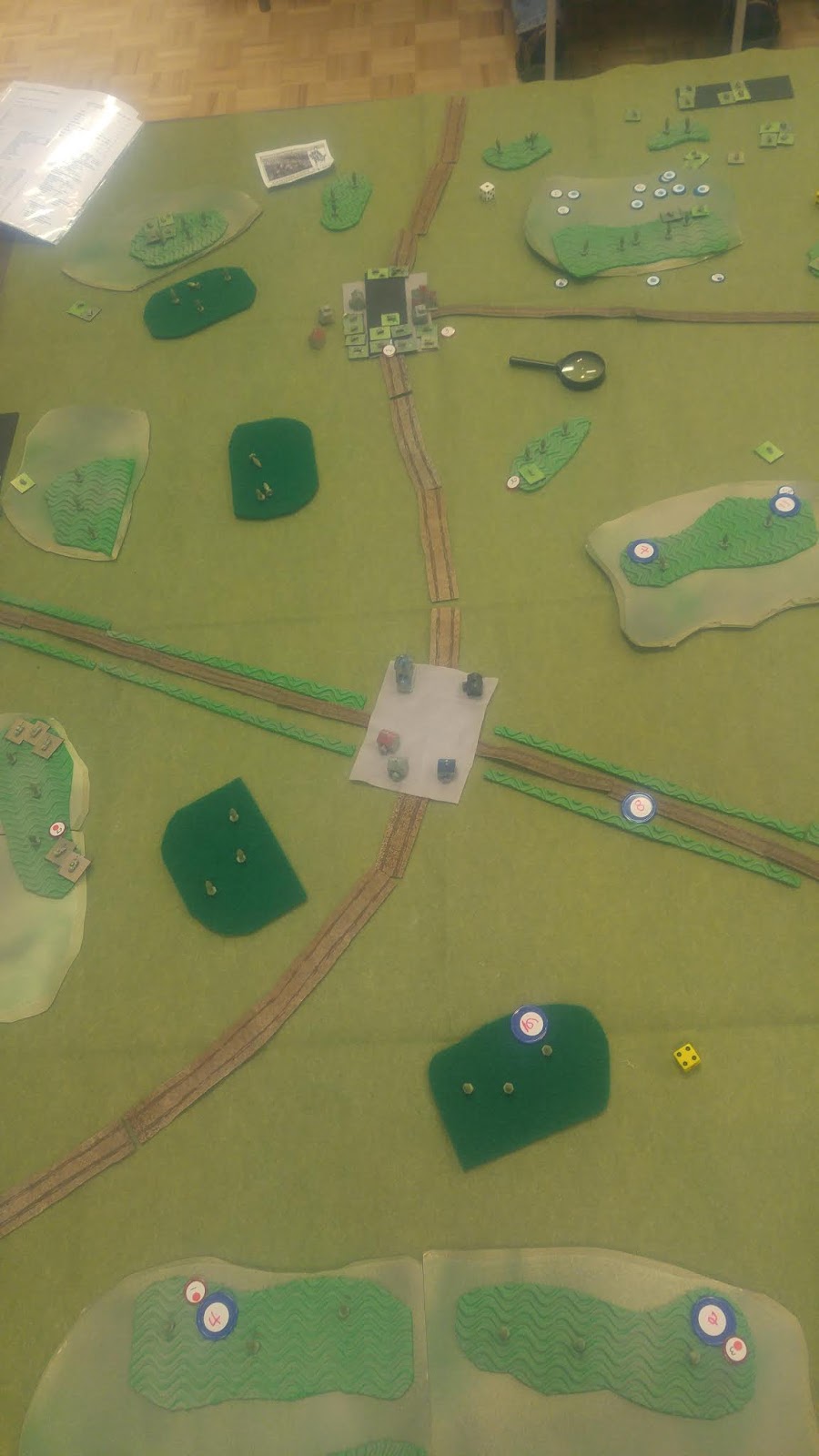 For the May meeting, I decided to get involved with some micro micro armour. 3mm to be precise and they are very good Oddzial Osmy (Picoarmour) models in that I can figure out what type a tank each one is supposed to represent.
I played the German commander of a Kampfgruppe composed of teachers and students from a tank training school pitted against a brigade of British tanks. Basically, it was their 45 tanks vs my 13. On the positive side, 4 of mine were Tiger 1s and 2s along with 5 Panthers. However, half the British tanks were Fireflies with those nasty 17lbers.
I decided on a defense on depth with the Panthers blocking the left, which represented the most covered approach. I put my junkiest units up front on the right, and the heavy hitting Tigers at the back to keep the range as long as I could for as long as I could. I put one minefield on the extreme left to prevent slipping around the back of the Panthers while the other minefield would prevent the British from setting up a good fire line on some key hills.
Things started out moderately well with the Panthers taking out some Shermans way out on the far right making up for the blindness of the student tank hunters on the right. That caused the one company to fall back.
 As a knock-on effect, the Sherman company on my left thought better of going up the centre out in the open and went around the hill to my far left. While they were doing that, my Panthers, Tigers, and others proceeded to pound the centre Sherman company.
However, it was not entirely one-sided. As I was reducing the centre and right Shermans, they did manage to wipe out my two units of tank hunters, which left me with nothing on the right. But while the remnants of the centre and right companies worked their way down the right (joined by the 4th company, which was created from earlier casualties), I turned my attention back to the leftmost Sherman company. A quick duel turned into a rout at the cost of a single Panther and the Sherman company retreated back around the hill, only to eventually reappear in the center after a couple of turns.
Eventually the weight of numbers began to tell as the Tigers brewed up under the attention of the Sherman companies on the right. Then the Panthers began to die until the German side had only one Tiger 2 and one Panther facing more than a dozen Shermans, at which we called the game. The Germans had killed more than 2 Shermans for each of their own casualties but it just wasn't enough against all of those Fireflies.
 Chris has written a pretty interesting set of rules that have a lot of potential. They flow well and are pretty simple. I think the one refinement that needs to happen is to ditch the precision of the gun penetrations and adopt the simpler system he has for the armour.
Subscribe to:
Comments (Atom)