Friday, January 30, 2015

How to fence

Here's my basic steps for creating fences for 28mm figures:

Materials:
  • 6" large tongue depressors
  • Matchsticks
  • White glue
  • 30 gauge florist's wire or similar. The florist's wire is thin and flexible enough to bend easily but it's quite sturdy
  • Brown craft paint and mid-grey paint
  • Turf mix (mine started out as 2 parts fine to 1 part course but I think there's far more fine now)
  • Optional: scalpel or chisel-blade for an exacto knife
Steps:
  1. Start by drilling 3 holes into the tongue depressors. The holes should be slightly smaller than the matchstick.
  2. Dab a bit of glue on one end of the matchstick and stick it into the hole. If the hole is slightly smaller, you might have to rotate the matchstick a bit to knock the corners off to get it into the hole. The tighter the fit, the better. Repeat for the other two holes.
  3. When the glue is dry, use the scalpel or chisel blade to flatten the bottom if the matchstick pokes through a bit.
  4. Slap the brown paint over the entire construction.
  5. Take about an 8" length of wire and curl a little hook into it. Put that on one of the end posts and then wrap the wire so that you have complete loop.
  6. Keeping some tension on the wire, loop around the middle post and then loop around the other end post. Snip off the excess. Dab a little white glue on the loops to keep things in place. If you have bit sticking out from the snip, encase it with white glue.
  7. Add a second wire to the fence repeating steps 5 and 6.
  8. Cut the posts just above the upper wire. Paint the ends brown
  9. Take some grey paint and dry brush the grey on keeping some of the brown exposed in lower areas.
  10. Apply white glue to the brown tongue depressor.
  11. Apply your turf mix to the glue.

Tuesday, January 27, 2015

Fencing

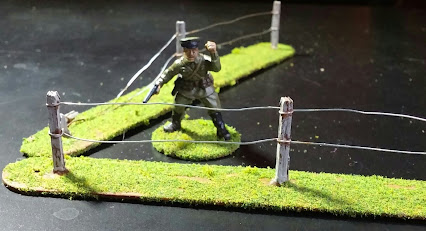
Time for some crafts. I've started to create some fences for my 28mm figures. Here is the first couple, which are simple "Do not trespass" style wire fences. In Chain of Command, they might prevent "on the double" movement but that is about it.


On the second fence, the post snapped as I pulled the wire tight. So we have a broken fence instead of a fully intact one. Not a problem.

Sunday, January 25, 2015

Objectives for 2015

This is usually something that you do for the first few days in the new year, but I'll do it now.

These are the things I want to do for 2015 but not necessarily in this order:
  • Finish the supply train and camps for my 2mm ACW armies
  • Work on my Adler 6mm Germans. I have a lot so completing them is not realistic
  • Try and finish all of the 6mm vehicles that Stephen gave me to paint plus all of my vehicles
  • Create barbed wire obstacles,for 28mm figures
  • Create minefield markers for 28mm figures
  • Create bocage and hedges for 28mm figures
  • Create trees for 28mm figures. I now have the armatures and clump foliage
  • Cut up a cobblestone mat to create city roads for 28 mm figures
  • Repaint and rebase the pine trees for 28mm figures. These are Christmas diorama trees that I picked up for half price.
  • Create more smoke markers
  • Create explosion markers for 28mm figures
Plus I want to pick up some more 28mm Russian troops, a 28mm Russian AT gun, some 28mm Germans, some MDF buildings, and anything else that strikes my fancy.

Sunday, November 30, 2014

Campaign for Big CoC

A couple of weeks ago, we kicked off a Chain of Command campaign using the Big rules for Chain of Command. It was Canadians vs the 12th SS in a slightly shorter -2 to 4 campaign ladder.

Game 1


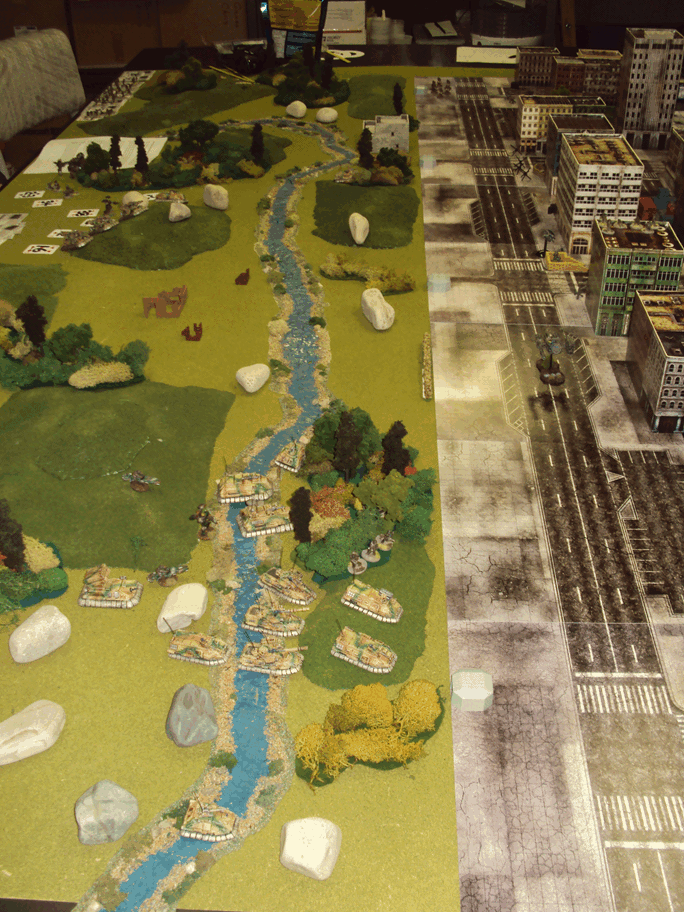
The first game was a shortish affair in which the Germans thoroughly out-scouted the Canadians. In this pic, the Germans started from the right.

While the Canadians tried to push hard on the flank, the Germans went straight up the middle and managed to get a jump off point close to the Canadian side and forcing the corresponding Canadian jump off points back to the table edge.


 The Canadians sent a section on the left flank and also sent a section against the German JOP in the center. A bold gambit to seize the JOP went badly as Richard rolled miserably for movement.


The Germans countered with an MMG. David didn't roll particularly well, so he added a squad (for 24 D6 of firepower).


After taking casualties in one section and accomplishing very little on the flank, the Canadians smartly withdrew.

Chalk one up to the campaign effect, in which the Canadian's chances of winning were small and the price would have been heavy regardless of outcome, so the effort was cancelled.


Game 2


With the campaign initiative, the Germans elected to strengthen their defenses. The initiative passed back to the Canadians. We rearranged the terrain a bit to reflect a slight change in the axis of the Canadian attack.

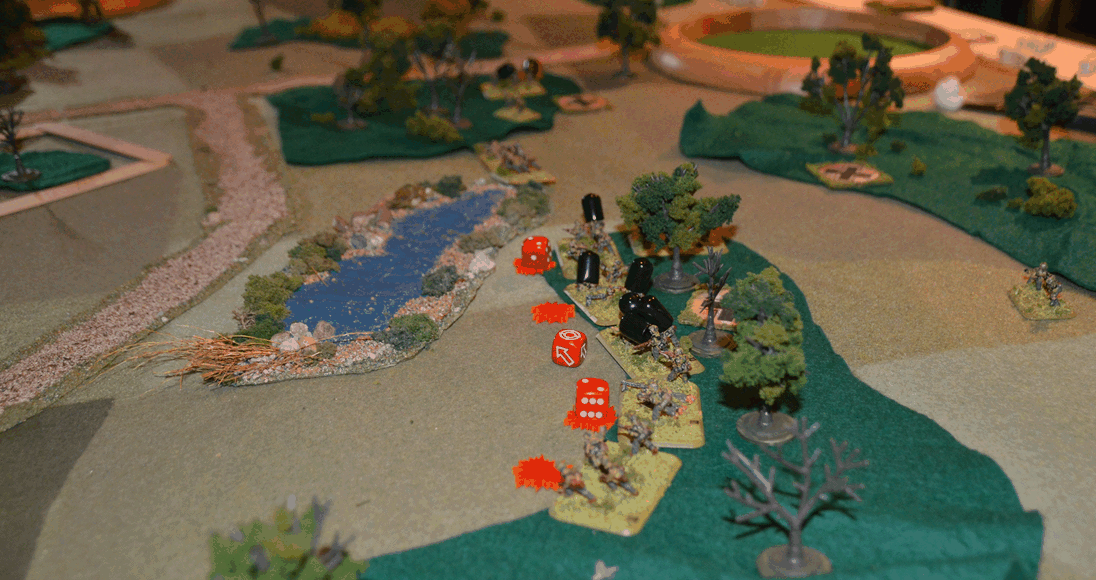
In this picture, the game is already several phases old. Ray deployed one section in the lighter green woods.


Stephen and David countered by deploying four sections against him. The weight of all that fire (half at close range) broke Rays section after a couple of phases. Ray deployed a second section that eventually suffered the same fate.


But the Germans had fallen into a trap. I was running the attached troops and I had selected a section and a FO. I deployed both of them and in a couple of phases had two German squads under a mortar barrage. The next phase, I moved it over 6" and added a third squad and one soldier from the fourth. The effect was devastating to the German squads as they all took some casualties.


Meanwhile, on the left, Richard had deployed a section, which prompted Stephen to deploy a squad in the center. I added a Sherman to turn the long range fight into a more equal affair. 


The Sherman's HE proved to be the difference maker so Stephen deployed a 'Shrek team. It's one shot immobilized the Sherman. It didn't get a second shot. The Sherman was immobilized in a good position where it could intervene in the center or on the right.

With the German center and right losing their firefight and still being a bit shaken with how devastating the mortar barrage had been on the left, the Germans elected to preserve their manpower and withdrew.

Game 3

The Canadians decided to advance on the main line of resistance. Having two sets of replacements available, the Canadians used one to top off their sections to bring them close to full strength. The Germans declined to use their one replacement draft. Once again, we rearranged the terrain a bit and added some hills and buildings.

I started off by deploying the tank and putting it on overwatch. Ray deployed a section on the right and started advancing through the woods. Richard deployed a section on the left, but due to poor scouting, he was once again forced to start from the edge. However, this wasn't as bad a disadvantage as previously because the German JOPs were a distance away and not in direct sight.

Stephen brought on the 'Shrek team again but this time they were far more successful. 9 hits out of 13 meant I didn't even need to make any defense rolls. Bye bye Sherman.

However on the right, Stephen deployed a German squad to stop the Canadian advance. Ray countered with a second section to make the dice thrown by both sides fairly even.


But the weight of numbers (and some better die rolling too) soon began to tell as the shock piled up on the ever shrinking German squad. Ray ordered up some close combat and that was the end of the German squad.

Meanwhile, on the left, David's Germans began a leisurely advance against Richard's Canadians hunkered down in the woods. Being in cover and tactical helped slow down the casualty rate and bringing on other units help whittle down the German attackers.


But there was an ominous clanking sound in the distance as a PzIV made its way onto the battlefield.

It was targeting Richard's Canadians when the tank commander got word to withdraw. Alarmed with Ray's progress towards the German JOP on their left, the Germans elected to fall back.


Sunday, October 26, 2014

Painting 2mm figures


Many people ask me how I paint something so small. Well, there's a few tricks but it's not quite as hard to do as you would think. The other key thing is to paint the figures much brighter than you would larger figures so that they stand out better.

Materials 

  • Plasticard (styrene) or some other mounting material such as MDF or chipboard.
  • Black primer (a matte primer is best but a satin finish is fine. I use cheap rattle can stuff).
  • 1 small paint brush with a really good tip. 
  • 1 small paint brush that no longer has a good tip for drybrushing. 
  • 2 really good lamps so that you can see what you are doing without shadows.
  • Paints (model and craft). 
  • Flock or other ground cover material.
  • Steady hands or a good desk to lean on. 

Recipe

  1. Mount the figures on some plasticard (styrene).
  2. Start by spraying the miniatures with the black primer. This provides a good background and seal for your painting.
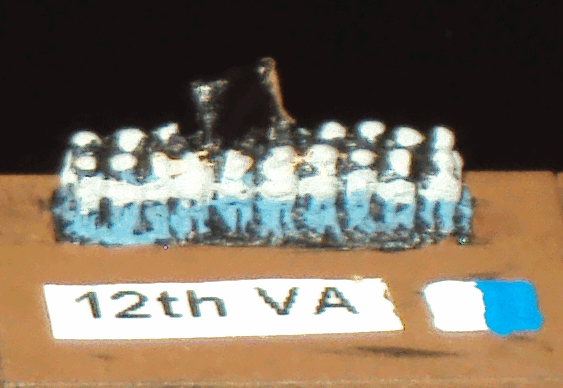
  3. Paint the plasticard brown with some craft brown paint. I use craft paint for this because it is cheap. I use the model paints for the rest because they contain a lot more pigment and have better coverage. On my plasicard, I've added a name and a colour code to indicate which brigade and division it belongs to.
  4. Using the tatty brush, dry brush the legs. If you don't know what dry brushing is, it's where you dip the brush in the paint and then wipe off most of the paint on a paper towel before you paint the figure. You don't have to be all that neat here. The only real key is to have the paint hit the legs and leave the non-leg area black.

  5. Using the tatty brush if it's not too tatty or the fine brush, paint the torso of the figures.

  6. Using the fine brush, paint the guns held by the figures. If the torso is a darkish colour, choose a lighter brown for contrast. If the torso is a lighter colour, go darker. This step is where you need more finesse and fine motor skills. I find I can get about 4 guns done per dip when the paint is fresh on the palette and less as the paint gets thicker. You'll need to clean off your brush between dips and get rid of moisture. The key is to paint thick and don't let the paint flow off the guns and onto the uniforms.
  7. I like to add hands to the guns to provide that pop of detail but it's really only worthwhile if the gun colour is on the darker side. Choose a bright and light flesh colour. I use the fine brush or sometimes I'll use planter's wire. Just dip a small dot where each hand would be. If you have too big a dot, go back with the brown colour and paint the dot smaller.
  8. Paint the face on the front and top of the heads. Not too much precision here as long as you don't get the flesh colour on the uniforms or down between the figures.
  9. Paint the top and backs of the heads with the hat colour.
  10. Paint the flag. I had to paint the flag white first because my red and blue paints are a little light in the pigment department, and on black, they go too dark. The white makes the other colours pop. I painted the red triangles first to leave the white cross. Then, counter-intuitively, I painted the blue as dots. I put enough dots that they sort of blend together with some white showing through to represent the white stars on the flag.
The whole key is to leave the impression that it's precisely painted. It really doesn't have to be. A pop of flesh colour in the general location of the face is good enough. Similarly, a couple of tiny bits of white will represent a bunch of stars on a flag. The suggestion is enough. People's minds will fill in the details for you. Here is the final result after painting the base green and flocking it:

Remember, these guys are half the size of a grain of rice. They don't need much detail to look good.

Tuesday, October 21, 2014

Gruntz from a while back

More than a while back, we had a gaming session at Stephen's place. He set up a game of Gruntz. I was on the Kraavak (whatever the spelling is) defending a recently taken over city from the humans.
I was given the task of defending the left flank. Basically, the bottom of the picture to just beyond the tall red building. I put my two infantry squads in the lower buildings along with an APC to carry them if the humans attacked the right and I needed to get them over to the other side. A plasma cannon and crew manned the checkpoint. A heavy skimmer was parked between the red building and the lower building while my heavy tank was parked in the entrance to a underground car park on the other side of the red building. My commander was in the top floor of the red building but he had a zip line to his mech ready to go so that there was no waiting for the elevator or running down the stairs.
Here come the humans. Apparently, our patrols weren't very good. However, the humans were cautious so we were given time to man our vehicles.


After an initial slow start, the humans (Justin specifically) got brave and charged forward. My lurking heavy skimmer got off two long range (and somewhat lucky) shots at a human APC. Poof. Along with the squad it was carrying.
Two human tanks zipped between the buildings to deal with my lurking APC. However, it was tipped off to the impending danger by my infantry and was ready. Two lucky shots from overwatch fire dealt with the first one. I made sure my APC got an early activation to damage the other tank and my second heavy skimmer finished it off.

Meanwhile, another human APC dropped off a squad to enter a building. My waiting squad poured into them and almost wiped them out. My first heavy skimmer put a beating on the APC.

My other squad dealt with the "medic" so that there were no resurrections happening.
The two infantry squads then combined to take out the hurt APC. The remaining APC ran for the hills while picking up the surviving infantry.

In this image, you can see the my heavy skimmers, which were untouched. My commander, though, had recklessly ventured into the open to support the infantry and was in turn heavily damaged. Had we gone another turn, I would have had him run for cover. My heavy tank had to content himself with an AA role and helped down a heavy VTOL carrier.


Friday, October 3, 2014

Progress on my 2mm ACW troops

Now that I've completed all of my 28mm Russians, I've returned to my 2mm Americans. When I last left off, I have based and painted all of the ones I had. What I hadn't got to was labeling them and flocking the bases.

I've done that now. I have completed the entire 2nd Corps of the Union army at Antietam, the Cavalry Corps, and started on the 1st Corps. Here's a shot of the 2nd Division of the 2nd Corps:

I used the trefoil symbol that the 2nd Corps used and also the colour system they used within the corps to denote the division. Red for the first division, white for the  second division, and blue for the third division. I expanded on that to surround the trefoil with a colour for the brigade.

Here I have a picture so that you can see sort of what this looks like from the front. I'm rather pleased with the result.